Culture-Defining Marketing: How Heinz Turned "Draw Ketchup" Into an AI Case Study
How a 150-year-old condiment brand used generative AI to prove a simple idea: when you say ketchup, the world pictures Heinz.
Few brands could survive an experiment this risky. Ask a machine to imagine a product with zero mention of your name, and let the internet judge the result. Heinz did exactly that, not once but repeatedly, and turned the outcome into one of the most talked-about campaigns of the generative AI era. This is the story of how a legacy brand made artificial intelligence its unofficial spokesperson.
The Origin of an Experiment
In 2021, Heinz asked ordinary people to draw a ketchup bottle from memory. Almost every sketch came back looking unmistakably like a Heinz bottle: the keystone label, the exact shade of red, the familiar shape. It was a simple insight with a powerful punchline — people don't just buy ketchup, they picture Heinz.
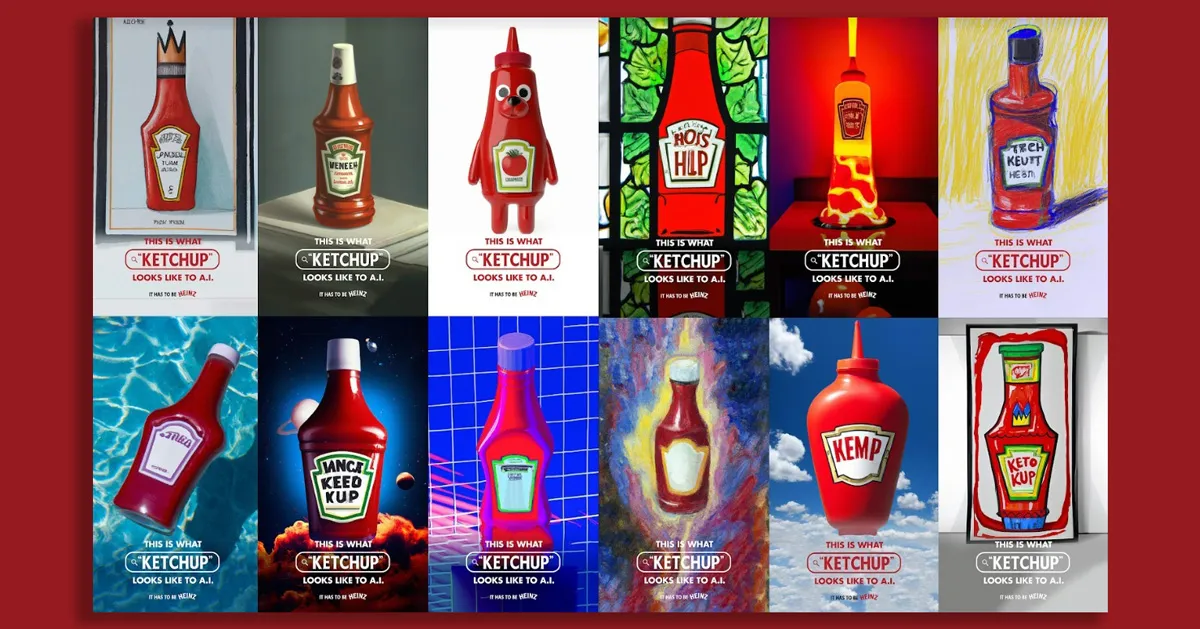
A year later, when text-to-image tools like DALL·E 2 became the obsession of the internet, Heinz saw the natural sequel. The team fed the model plain, unbranded prompts such as "draw ketchup," "ketchup in outer space," and "ketchup tarot card." The AI, trained on the collective imagery of the internet rather than any brand deal, kept returning bottles with that same keystone silhouette and signature red. Heinz had not asked a computer to advertise for it. The computer did anyway.
Marketing Beyond the Product
Heinz didn't simply screenshot the AI outputs and call it a campaign. They built an entire creative universe around the insight. Special-edition bottles were produced using the AI-generated labels. Physical and metaverse art galleries displayed the imagery. Social audiences were invited to suggest new prompts, turning fans into co-creators of the brand's own advertising.
The tone throughout stayed playful rather than boastful. Heinz let the machine make the argument for them: if artificial intelligence, with no branding instructions at all, associates ketchup with Heinz, then the brand's dominance isn't a marketing claim — it's a measurable fact. That reframing, from "trust us" to "even the robots agree," is what made the campaign feel fresh rather than self-congratulatory.
Building a Cultural Legacy
The results validated the bet. The campaign generated well over a billion earned media impressions worldwide and drew coverage from major outlets spanning tech, art, and business press. Social engagement climbed well above the brand's historical benchmarks, and other companies began joining the fun with their own AI mashup requests aimed at Heinz.
Heinz has since continued investing in AI, moving from a one-off stunt to genuine infrastructure. The company built a custom generative engine, developed with an outside partner and powered by cloud AI tools, to scale packaging and marketing content across its wider portfolio of brands. What began as a clever ad idea evolved into a repeatable capability: faster production timelines, more personalized content, and consistent brand control across a much larger catalogue than ketchup alone.
Lessons for Brands
- Let Proof Replace ClaimsHeinz didn't tell people it was the definitive ketchup brand. It designed an experiment that let an unbiased third party — an AI model — prove the point instead.
- Ride the Cultural Wave EarlyText-to-image AI was a genuine cultural moment in 2022. Heinz moved fast enough to be one of the first major brands associated with it, earning outsized attention relative to its media spend.
- Turn the Audience Into CollaboratorsBy asking fans to suggest new prompts, Heinz transformed a one-way campaign into an ongoing conversation, extending its lifespan far beyond a single launch.
- Make the Legacy Brand Feel CurrentA 150-year-old product doesn't usually feel like a technology story. Heinz used AI specifically to reach younger audiences without abandoning the heritage that built its dominance in the first place.
- Treat the Stunt as a Starting PointThe real payoff came later, when Heinz's parent company invested in its own generative AI engine for everyday content production. The campaign wasn't just a headline moment — it was a proof of concept for a broader capability.
Conclusion
Heinz's AI ketchup work is a reminder that the strongest brand claims are the ones you don't have to make yourself. By letting a neutral algorithm do the talking, Heinz turned market dominance into a piece of entertainment, and then turned that entertainment into a lasting production capability. For brands with genuine category strength, the lesson is clear: find the experiment that lets the evidence speak, and build the story around what it reveals.